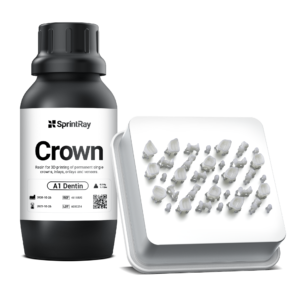


MIDAS RESTORE - PRE ORDER
£0.00


MIDAS RESTORE
CONTACT US FOR PRE ORDER: 01142766813 – sales@eurodontic.co.uk
If we could 3D Print Enamel, This is it.
SprintRay Midas Restore is a definitive restorative resin filled to more than 75% by weight with glass ceramic and zirconia — engineered for full-coverage crowns, inlays, onlays, and veneers. It holds 98% of its polish after 5,000 brushing cycles, resists wear five times better than SprintRay Ceramic Crown, and matches the translucency range of milled lithium disilicate. Scan, press, polish, deliver — in a single visit.
Midas Restore takes the opposite approach. Its resin matrix arrests cracks
rather than simply resisting them, and its flexural modulus sits closer to
dentin than to a glass ceramic. When adhesively bonded to remaining
tooth structure, the restored tooth distributes function as a single unit –
instead of concentrating stress at the interface.
Indicated for definitive full single crowns, definitive partial crowns
(inlays and onlays) in the anterior and posterior, and single veneers.
Available in five natural shades – A1, A2, A3, and B1 –
resin capsules are validated for use with Midas Digital Press.
https://www.eurodontic.co.uk/product-category/cad-cam/sprintray/sprintray-compatible-resins/
SPRINTRAY MIDAS RESTORE TECHNICAL DATA
Property
Biaxial flexural
strength
Flexural modulus
Surface hardness
Midas Restore
215 MPa max.
180 MPa mean
10.5 GPa max.
10.0 GPa mean
81.9 ± 6.4 HV
Test Method
ISO 6872, piston-on-three-balls
ISO 4049, 3-point
Vickers microhardness,
ISO-referenced protocol,
independently measured at the
University of Alabama at
Birmingham School of
Dentistry.
What It Means Clinically
Resistance to fracture under occlusal load. Crown HT 203
max/ 168 mean; Ceramic Crown 205 max / 170 mean.
Closer to dentin (17.5 ± 3.8 GPa*). A bonded restoration that flexes
with the tooth transfers load through the interface rather than concentrating stress at it. Crown HT 7.4 GPa; Ceramic Crown 5.8 GPa.
Statistically equivalent to a leading nanofilled direct composite,
and roughly double the hardness of previous-generation printed
restorative resins (20–39 HV). Contributes to wear resistance and
polish retention.
Regulatory Status
CE marked – Class IIa medical device under
Regulation (EU) 2017/745 (EU MDR)
FDA 510(k) – K260661 · Class II · 21 CFR 872.3690,
Tooth Shade Resin Material · Rx only
Composition
More than 75% filler by weight – a dual
filler system combining glass ceramic
and zirconia powder in a lightcurable methacrylate resin matrix.
Test conditions
Unless otherwise noted, all values were
measured on specimens pressed on the
Midas Digital Press and post-processed
per the validated SprintRay workflow.
SURFACE & OPTICAL
PHYSICAL & SAFETY
CLINICAL HANDLING NOTES
Property
Gloss retention
Wear resistance
Translucency
parameter (TP)
Shade and color
stability
Polishability
Midas Restore
98% of initial gloss at
5,000 cycles
5x SprintRay Ceramic
Crown; comparable
to a milled hybrid
ceramic
13.5 (shade A1)
Pass
Polish to final
What It Means Clinically
A surface that holds its polish through daily brushing
resists staining and biofilm accumulation.
Wear performance in the range of a milled restoration, and
five times that of our previous-generation definitive material.
• Milled lithium disilicate HT 13.9
• SprintRay Crown HT 13.4
• SprintRay Ceramic Crown 10.9 (varies by shade).
Shade does not change under accelerated aging.
Green state zirconia or hybrid ceramic polishing systems.
No glaze required.
Test Method
Simulated
toothbrush abrasion
in water.
Internal testing on specimens,
200,000 cycles. No ISO
standard exists for this
method.
Higher TP = more translucent.
All materials measured under
the same protocol.
ISO 10477, after irradiation
and water sorption
ISO 10477 surface finish
MECHANICAL
Midas Restore
22–24 µg/mm³ (limit <40)
1.0–2.5 µg/mm³ (limit <7.5)
Not detectable
Radiopaque –
equivalent to aluminum
Pass
Pass
What It Means Clinically
Dimensional and optical stability in the oral environment.
Resistance to dissolution in the oral environment.
No detectable residual methyl methacrylate.
Margins and recurrent caries are assessable radiographically.
A restoration only works if it stays attached. Measures how firmly
the material holds to the tooth once cemented. A crown that
debonds fails the patient just as surely as one that fractures.
Tested for tissue contact exceeding 30 days.